

For small business owners running on tight margins, marketing often feels like a choice between staying visible and staying solvent. Budget constraints make every decision heavier, especially when customer acquisition challenges demand consistency, testing, and patience. The reality is that throwing money at ads rarely guarantees results, and chasing every new channel can drain time as quickly as cash. With cost-effective marketing and affordable marketing strategies built around what already works, marketing impact becomes measurable, repeatable, and sustainable.
Quick Summary: Budget-Friendly Growth Plan
- Use social media marketing to reach customers consistently without overspending.
- Use email marketing to build relationships and drive repeat business at low cost.
- Use local SEO to improve visibility in search and attract nearby customers.
- Use content marketing strategies to educate your audience and earn trust over time.
- Use partnership marketing to expand reach by collaborating with complementary businesses.
Create On-Brand Visuals in Minutes to Post More Often
Once you’ve picked your fastest, budget-smart moves, consistency gets much easier when visuals aren’t the bottleneck. Instead of paying for a graphic designer or photographer every time you need fresh creative, use a tool that helps you generate engaging images for your marketing, so you can keep your look on-brand while moving quickly. With an AI image generator, you can type a simple text prompt and instantly create AI images that streamline the process of producing visual content to promote your brand. That means you can keep showing up with eye-catching graphics across the places your audience actually sees you, social posts, email headers, blog images, and even simple ads, without slowing down your publishing pace.

Build a Low-Cost Marketing Plan You Can Repeat
A simple plan turns scattered efforts into steady progress, even if you only have a few hours a week and a small budget. The goal is to focus on the people most likely to buy, show up in the right places, and learn what works before you spend more.
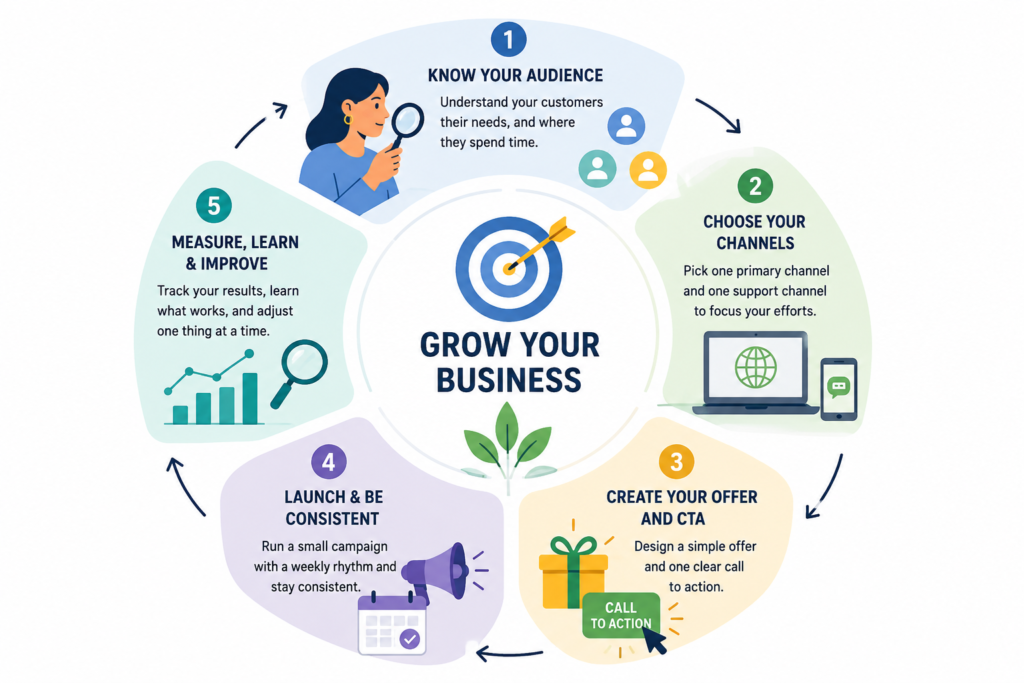
- Define your audience with quick research
Start with the basics: who you help, what problem you solve, and what someone is trying to achieve when they find you. Use a short customer chat, a one-question survey, or a review audit to spot patterns, because the market research process helps you discover who is most receptive before you choose tactics. - Choose one primary channel and one support channel
Pick the single place where your audience already pays attention, like email, local partnerships, a social platform, or search content. Add one support channel that feeds the first one, like short social posts that push to an email signup, so your effort stacks instead of spreading thin. - Set one goal, one offer, and one call to action
Decide what success looks like for the next 30 days, such as booking calls, getting store visits, or collecting email subscribers. Create a simple offer that matches that goal, then write one clear call to action you will use everywhere to reduce decision fatigue. - Launch a small campaign with a weekly rhythm
Run a tiny test you can sustain, like one helpful post plus one invitation each week, or a low-dollar ad for your best offer for seven days. Keep the message consistent and reuse the same core visuals and wording, because repetition is what gives you reliable signals. - Measure, learn, and adjust one thing at a time
Track just a few numbers that match your goal, like clicks, replies, bookings, or sales, using a simple spreadsheet or dashboard. A marketing measurement framework keeps you focused on what to measure so you can change one variable, compare results, and improve without wasting money.